

💬 “We've been married 12 years, but I started this 401(k) way before we met… How do we figure out what's mine?”
If you're going through a divorce in Florida and your retirement account predates your marriage, the first step is usually to determine the value of the account on the date of marriage. That lets us draw a clear line between what's premarital (yours) and what's marital (shared). But what if those records are long gone?
It happens more often than you'd think—and Florida courts have a way to deal with it.
🧮 When Records Are Missing, We Use the Coverture Fraction
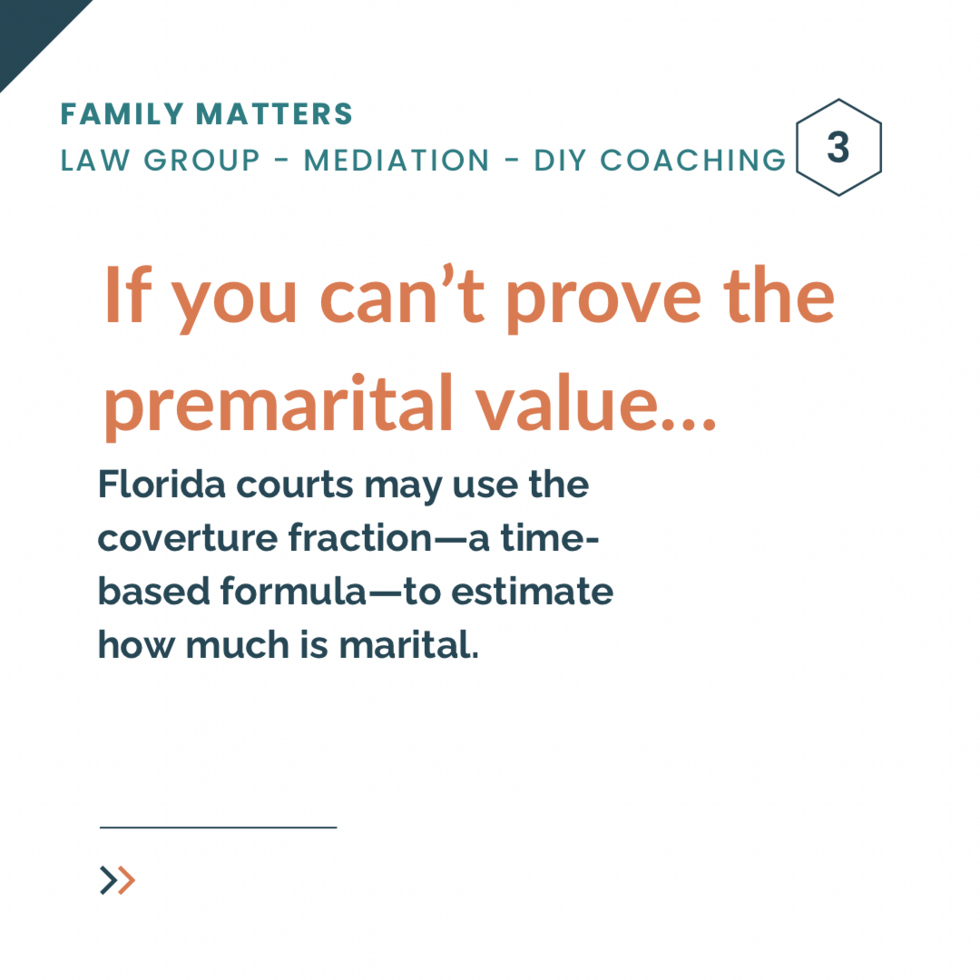
If you can't prove the value of your 401(k) at the time of marriage, courts may apply what's called a coverture fraction to estimate the marital share. It's a way to approximate how much of the account should be treated as marital property—even without exact numbers.
Here's how it works:
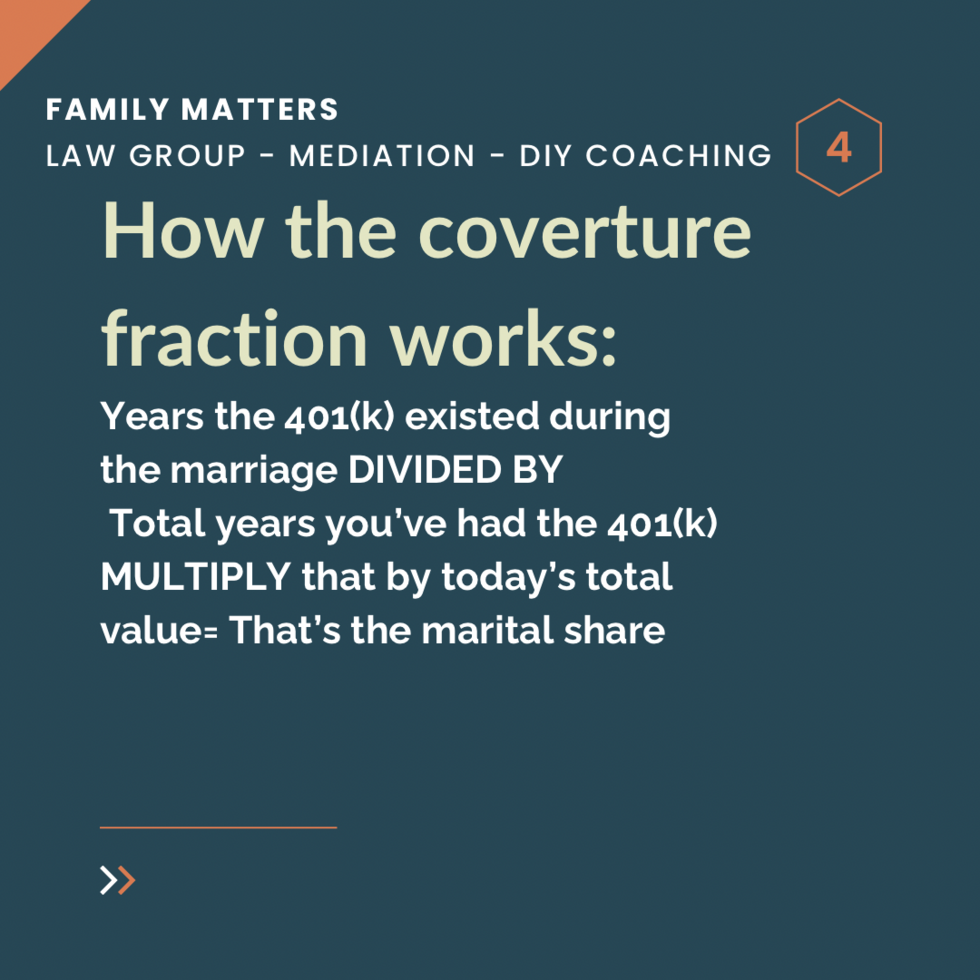
- Numerator: Years (or months) of the 401(k) during the marriage
- Denominator: Total years (or months) of the 401(k)'s existence
- Multiply that fraction by the current total value of the 401(k)
- The result is the estimated marital portion subject to division
🔍 Real Example:
Let's say you've had your 401(k) for 20 years, but were only married for 10. The court may determine that 10/20 = 50% of the total value is marital.
So if the account is worth $200,000 today, $100,000 could be considered marital—even though no one knows the exact value on the wedding date.
⚠️ But Wait—It's Not Always That Simple
The coverture method is an estimate, not a perfect science. There are a few things you should consider before assuming it's the best or only option:
- 📈 Did the account grow a lot before the marriage?
You might be giving up more than you need to if you don't at least try to trace those early contributions and growth. - 🛑 Was the marriage short but the account old?
Using the coverture method could unfairly overstate the marital portion. - 👎 Was the other spouse barely contributing?
Maybe the account grew from market gains, not ongoing effort—and that could matter.
If you're the spouse trying to protect your retirement savings, the burden is usually on you to prove what portion is non-marital. And if you're the spouse trying to claim part of the account, you need to be ready to show what portion was earned during the marriage.
When exact numbers don't exist, the court will rely on what's most fair—but fair doesn't always mean equal.
💡 Pro Tip from Family Matters Law Group, P.A.:
If you're dealing with missing financial records or unclear account values, don't panic. We've helped plenty of clients navigate this issue—whether by working with a forensic accountant, negotiating a fair coverture-based split, or raising creative arguments that account for unequal growth or investment risk.
Sometimes, doing what's equitable means adapting to what's actually possible—and we know how to do both.
👣 What to Do Next:
- If you're in the early stages of divorce, ask for all retirement statements ASAP.
- If you can't locate old records, get a letter from the plan administrator confirming how far back records go.
- Consider a flat-fee strategy session with our team to map out options and prepare for settlement or trial.
We offer legal representation, coaching, and unbundled document help across Florida—and we know how to break down complex financial questions in a way that makes sense.
✅ Bottom Line:
If the premarital value of a 401(k) is missing, Florida courts often use a coverture fraction to determine the marital share. It's not perfect, but it's a practical solution when detailed records no longer exist. Whether you're trying to protect what you earned or get your fair share, you don't have to navigate this alone.
📲 Need help?
Schedule a strategy session or explore our flat-fee options:
👉 https://www.familymatterslawgroup.com
Or check out our DIY Legal education tools:



Comments
There are no comments for this post. Be the first and Add your Comment below.
Leave a Comment